

For accelerator and incubator teams, negotiation training is often a single session in the program calendar. At TU Wien i2c, we took a different approach: a full year of negotiation training for deep tech founders, designed and delivered by Konsultori. It came in the form of one bootcamp and six live deep dives in a blended learning format. I bring 20 years of negotiation practice from M&A, fundraising and partnership deals to the classroom.
Deep tech founders negotiate far more often than they realise. A licence with the university, a pilot with a corporate partner, a term sheet with an investor, a supplier contract, the first key hire, the equity split with a co-founder: each of these activities is a negotiation, and each one shapes the company for years. Yet negotiation is rarely treated as a core founder skill. It is usually covered in a single session on negotiation techniques, if at all, and then left to instinct.
That gap is the reason TU Wien i2c, with Ludovica Vanicore, Deep Tech Program Manager at TU Wien, and Alexandra Negoescu, Senior Program Manager for Scientific Service Portfolio at TU Wien, invited me to run a full year of negotiation training for the deep tech startups in their cohort. The starting point was a shared conviction: negotiation is part of a founder’s daily work, and like any skill that matters, it only has a measurable effect on the business when it is trained repeatedly and in context.
Across 2025 and 2026, we delivered one bootcamp and six deep dives, each built around a negotiation with a use case that deep tech founders actually face. This post wraps up the year: how the curriculum was structured, how the blended learning format worked, what each session focused on, and what accelerator program managers can take from it when designing their own programs.
Why Negotiation Training Needs a Year, Not a Day
A one-day negotiation training can raise awareness. It rarely changes behaviour. Founders leave with a framework, go back to a week full of urgent product and fundraising work, and the next real negotiation happens under time pressure with the old habits intact.
We designed the program the other way around. Instead of compressing everything into one session, we spread the training across the year and anchored each module in a specific relationship: customers, partners, investors, suppliers, employees and co-founders. This had two effects. Founders could connect each session to a negotiation they were facing at that moment, and the core principles from the bootcamp were revisited six times in six different contexts, which is where real skill building happens.
The Curriculum: One Bootcamp, Six Deep Dives
The program started in autumn 2025 with the Negotiation Bootcamp, which is also available digitally via the Konsultori Academy, followed by the first deep dive on sales and customers. In 2026, five further deep dives covered partnerships, investors, suppliers, employees and co-founders. Each deep dive ran for 2.5 – 3.0 hours.
The Blended Learning Format: Digital Foundations, Live Practice
The program combined two learning modes. The foundations sit in the Negotiation Bootcamp, which founders participated in live and could also revisit digitally and at their own pace in the Konsultori Academy. The deep dives were live sessions. This blended learning setup meant that live time with the cohort went into practice rather than theory, and founders who joined later could catch up on the basics before the next deep dive.
Every live session followed the same rhythm, and that consistency was a deliberate design choice.
A short, situation-specific input.
We covered only what is distinctive about negotiating with that particular counterpart. The general foundations had already been laid in the bootcamp, so the deep dives could go straight to the terms, dynamics and pitfalls that matter in that setting.
A live, case-based role-play.
Founders prepared a confidential role, then negotiated in pairs or small teams. The cases were built to reflect deep tech realities: licensing a patented invention, closing a supplier deal under a hard budget ceiling, hiring a key expert during a cash freeze, resolving a co-founder crisis under time pressure.
A joint debrief.
This is where most of the learning happened. We compared results across teams, looked at which agreements created value for both sides and which simply split the difference, and asked what made the difference.
An action plan, and a check-in next time.
Each session ended with founders naming one technique they would apply in their own business. The next session opened by asking how it went. That simple loop turned a year of sessions into one continuous learning curve rather than six separate events.
Seven Sessions, Seven Core Learnings for Deep Tech Founders
Below is one central learning from the bootcamp and each of the six deep dives. The full frameworks and cases remain part of the training itself, but these are the shifts in thinking we saw matter most for deep tech founders.
Bootcamp: Negotiation Foundations
The learning: Most negotiations go wrong before they start. Founders tend to prepare their position (what they want) and neglect their interests (why they want it), their walk-away alternative, and the interests of the other side.
What to focus on: Treat preparation as part of the negotiation. Know your best alternative before you sit down, map what the other side actually needs, and build rapport early. The bootcamp also covered negotiation styles, anchoring, framing and how to de-escalate when emotions rise.
Deep Dive 1: Negotiating with Customers
The learning: Founders often defend price based on their own costs. The stronger position is to anchor on the value the solution creates for the customer and to treat price as only one of several terms on the table.
What to focus on: Confirm the customer’s pain before presenting features, and never give a concession without asking for something in return, such as contract length, payment terms or reference rights.
Deep Dive 2: Negotiating Partnerships
The learning: In deep tech partnerships, the founder’s technology and the partner’s market access can create value that neither side has alone. If that potential is not defined jointly at the start, the conversation slides into arguing over costs.
What to focus on: Negotiate the size of the opportunity first, then the split. Pay particular attention to who owns IP created during the collaboration, how broadly the partner can reuse what it learns, and how far any exclusivity reaches. Map the people behind the table as well: corporate decisions are rarely made by one person.
Deep Dive 3: Negotiating with Investors
The learning: A term sheet bundles two different kinds of terms: the economics and the control. Founders also tend to underestimate how much leverage they lose once an exclusivity period begins.
What to focus on: Separate the “money” terms from the “steering wheel” terms, negotiate the critical points before signing, and remember the parties who are not in the room, such as the university’s technology transfer office and future investors.
Deep Dive 4: Negotiating with Suppliers
The learning: Startups are usually the small buyer facing a much larger vendor. Volume is not a lever, but runway protection, flexibility and non-cash assets are.
What to focus on: Trade what costs you little but matters to the supplier, such as visibility, product feedback or introductions, and structure payments around progress rather than upfront commitments. A key insight from the debrief: when budgets genuinely do not overlap, splitting the difference is not an option, and creative packaging becomes the only route to a deal.
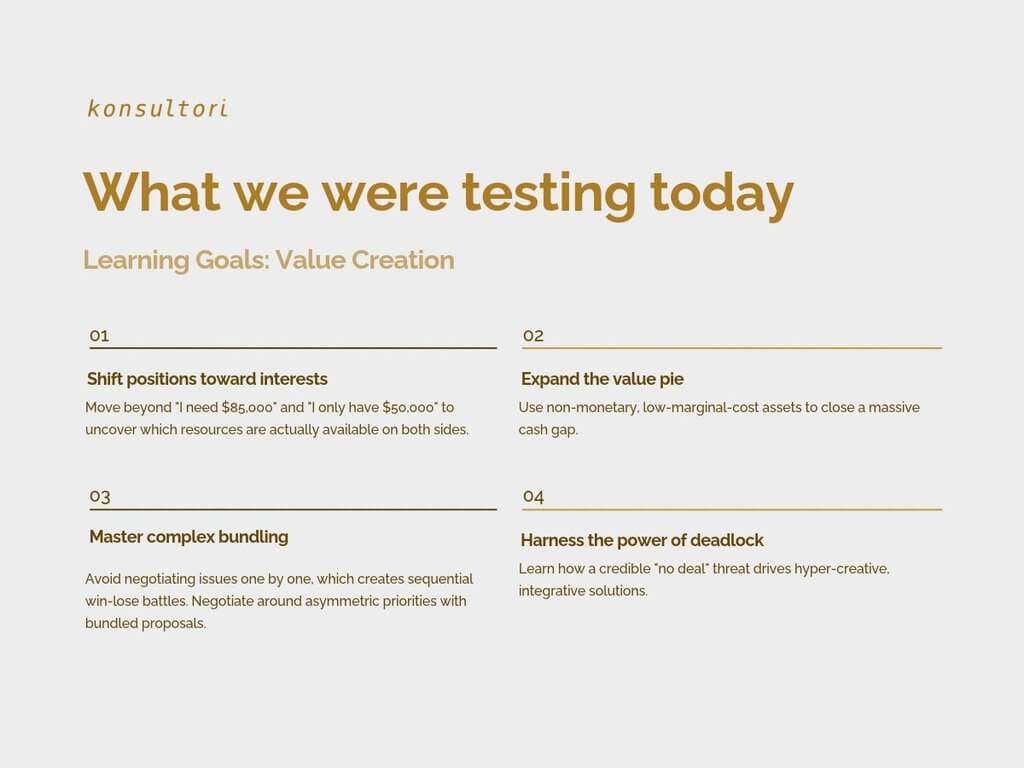
Deep Dive 5: Negotiating with Employees and Key Hires
The learning: Hiring negotiations are not one-off transactions. A win-lose approach on day one tends to cost far more later, and startups cannot compete on salary alone.
What to focus on: Negotiate total compensation across cash, equity and flexibility, and use “if-then” agreements tied to milestones or the next financing round to bridge the gap between what the startup can pay today and what the candidate needs.
Deep Dive 6: Negotiating with Co-Founders
The learning: Equal equity does not have to mean equal control, and a founder agreement is not a one-time signature. Without clear decision rights, a 50/50 split can paralyse a company the moment founders disagree.
What to focus on: Separate ownership from operational control, agree in advance how deadlocks are resolved, and revisit roles and commitments at defined milestones such as each financing round. More on this in our page on co-founder alignment for startups.
Five Negotiation Principles That Came Up Again and Again
Across very different counterparts, the same principles kept surfacing in the debriefs. By the end of the year they had become a shared language in the cohort.
- Avoid simple splitting. Meeting in the middle feels fair but often fails under real constraints, such as a hard budget cap or a fixed runway.
- Negotiate the bundle. Price, scope, timeline, IP and equity are easier to align when they are traded as a package rather than one by one.
- Use “if-then” contingencies. Milestones and future events can bridge disagreements that look impossible today.
- Share constraints wisely. Options cannot be co-created in the dark. Selective transparency builds trust faster than guarded positions.
- Know your walk-away point. No deal is a legitimate outcome when the alternative would damage your runway or your company.
One observation from the supplier and employee sessions stayed with us in particular: constraints did not make the negotiations worse. When cash was genuinely limited, teams that stayed in the conversation produced more creative agreements than a simple cash transfer would have allowed.
Five Lessons for Accelerator Program Managers
For accelerator and incubator teams, the year at TU Wien i2c offered some practical lessons on designing negotiation training that has a lasting effect on the cohort. Our Advanced Negotiation Workshop for Accelerators builds on these lessons.
- Follow the founder’s real calendar. Sequencing modules by counterpart (customers, partners, investors, suppliers, employees, co-founders) keeps each session relevant to what founders are facing at that time.
- Make practice the main event. Short inputs and long live negotiations with a structured debrief build skills that founders can use the following week.
- Build continuity into the program. Recapping the previous session and following up on action plans turns individual sessions into a learning curve.
- Use blended learning as an on-ramp. Having the bootcamp available digitally means founders who join a cohort later can catch up on the foundations before the next deep dive, and live time stays reserved for practice.
- Cover the uncomfortable conversations too. Co-founder and employee negotiations are often left out of programs, yet they are among the most consequential negotiations an early-stage team will have.
Designing Negotiation Training for Your Cohort
What does year-long negotiation training for deep tech founders look like?
In the TU Wien i2c program, it consisted of one foundations bootcamp and six 3.0-hour deep dives, each focused on one negotiation counterpart: customers, partners, investors, suppliers, employees and co-founders.
Why spread negotiation training across a year?
Founders can connect each session to a negotiation they are facing at that moment, and the core principles are practised repeatedly in different contexts instead of once in a single session.
How does the blended learning format work?
The foundations are available as a digital Negotiation Bootcamp in the Konsultori Academy. The deep dives are live sessions built around short input, a case-based role-play and a joint debrief.
Can accelerators book selected modules only?
Yes. The curriculum can be delivered in full or as selected modules, onsite or live online, tailored to the cohort.
Thank You
We want to thank TU Wien i2c, and in particular Ludovica Vanicore and Alexandra Negoescu, for their trust and for committing to a full year of negotiation training for their founders. Choosing depth over a one-off format is not the easy option for a program team, and it is exactly what gave the training its effect. And thank you to the founders, who brought real energy, real cases and real honesty to every debrief.
How We Can Help
- Advanced Negotiation Workshop for Accelerators: The full curriculum, or selected modules, tailored to your cohort, onsite or live online.
- Investor negotiations and readiness: Preparation for term sheet discussions and financing rounds, building on our Investor Readiness Check.
- Co-founder alignment: Facilitated conversations on roles, equity and decision rights that founding teams tend to postpone.