

An established SME should bring in an external business advisor when a decision is rare, expensive to get wrong and hard to reverse: a generational handover, a sale or acquisition, a major bank financing, or a margin problem the leadership team has already tried to solve. For running the business day to day, your own team is the better choice.
If you run an owner-led company, you have probably solved more problems yourself than any advisor ever will. That hands-on strength is what carried your company to 30, 50 or 100 employees, and we have a lot of respect for it. At some point, often somewhere between €5 million and €15 million in revenue, the way decisions are made starts to hold the company back. The owner signs off every quote, the leadership meeting returns to the same topic quarter after quarter, and margins slip while the order book looks full.
We see this pattern again and again in our work with companies in architecture, engineering and construction and in food production, in Austria and its neighbouring markets. In most cases the team is highly capable. What is missing is a structure that lets capable people decide. In this guide we share how to tell the difference, what to keep in-house, and what you can expect from a good advisor before you sign anything.
Signs Your Leadership Team Has Hit a Structural Growth Ceiling
The five clearest signs are: revenue grows while gross margin falls, the owner still approves every quote, middle managers escalate instead of decide, one topic has been on the leadership agenda for more than two quarters, and the succession or shareholder question has no date attached.
- Revenue grows, margin shrinks. Material prices and the annual collective agreement increases are passed on only partly, and sales defends volume rather than price. In construction and engineering we see this in fixed-price bids calculated on last year’s cost base. In food production it shows up in retail listing terms that quietly absorb the margin of every new product.
- The owner is the approval bottleneck. Quotes, hires, supplier changes and discounts all run through one desk. The company can only grow as fast as that person’s calendar allows, and the people around them have little room to build judgment of their own.
- Middle management administers instead of leads. Many of your best technicians and project managers were promoted into leadership roles without clear authority, targets or support. They keep the operation running reliably, but they push the real decisions upwards because nobody has told them they may make them.
- The same topic has been on the agenda for two quarters or more. A new market, a pricing change, a reorganisation of sales. Everyone agrees it matters, but nobody owns it, and each meeting ends with the plan to look at it again next month.
- The succession or shareholder question has no date. The next generation has not yet committed, the shareholders see the company’s future differently, or a sale is an option nobody has priced. These conversations are personal and often difficult, and the longer they wait, the fewer options remain.
One of these signs is normal in any growing company. When three or more appear at the same time, it usually means the company has outgrown the decision structure that built it. That is a sign of success, and it is the moment when an outside view tends to pay off most.
In-House vs. Outside Advisory: The SME Resource Matrix
Keep in-house everything your team does regularly and knows better than any outsider. Bring in outside advice when the situation is new to your leadership team, when the stakes exceed a year’s profit, or when the people who should solve it are part of the question themselves.
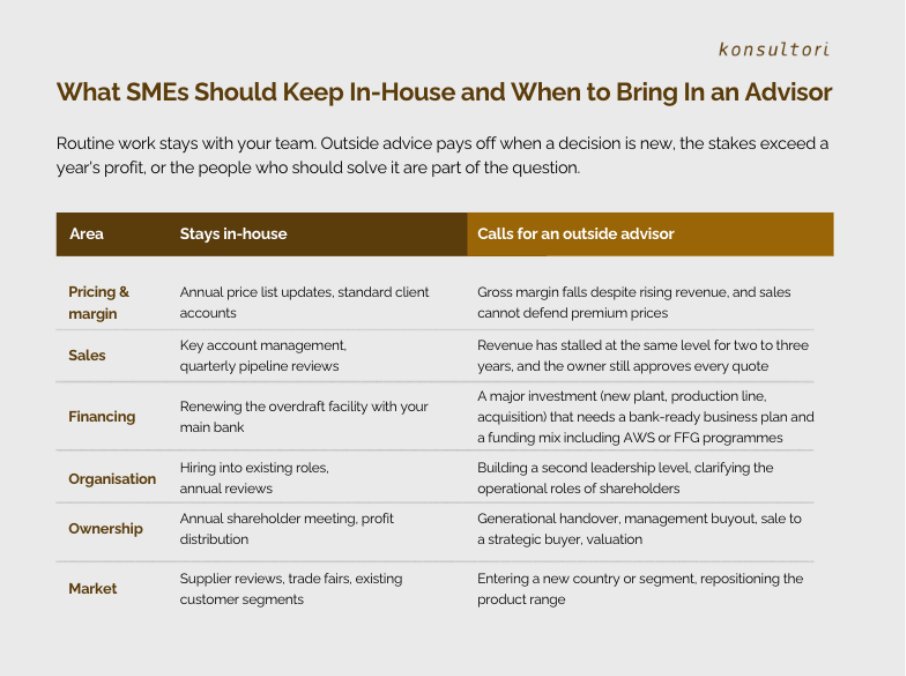
Tax and legal questions stay with your tax advisor and lawyer. We work closely alongside them, or with trusted partners from our network, because every strategic decision eventually becomes a contract, a new entity or a change in ownership.
Core Advisory Areas for SMEs
For established SMEs, outside advice usually falls into four areas: growth strategy and sales, corporate finance and bank financing, succession and M&A, and organisation and leadership. In practice these topics are connected, so a good advisor looks at the whole picture rather than one symptom.
Growth strategy and sales.
Breaking through a revenue plateau, sharpening core competencies, building business development and key account management, and preparing entry into new markets.
Corporate finance and bank financing.
A financial business plan that passes conservative bank underwriting, investment cases, liquidity planning and the right combination of bank loans and public funding.
Succession and M&A.
Preparing for handing over to the next generation, a management buyout or selling the company, including valuation and shareholder alignment.
Organisation and leadership.
Building a second leadership level, defining decision rights, and bringing the shareholders and leadership team onto a shared direction.
We cover strategy, financing and organisation ourselves. The question a client brings to us is rarely the whole question: a financing request turns out to be a pricing topic, recruiting difficulties turn out to be about leadership, and a market entry plan leads straight to the succession question.
From generational change to international growth: an AEC example
An Austrian engineering and planning firm with around 70 employees approached us at the start of a generational change. The new leadership wanted to redefine the firm’s core competencies and build a sales and business development approach that no longer depended on the founders’ personal networks.
We started with the strategy for sales and business development and supported the team as they put it into practice. Over the following years our collaboration grew: an annual strategy review with the whole leadership team, ongoing leadership alignment, a professional marketing setup, key account management for the most important clients, and entry into a new international market. Alongside this, we prepared the shareholders for the succession question and developed an M&A strategy. The firm has since doubled its revenue.
How Konsultori Works: Coached Implementation Instead of Shelfware
We do not hand over a strategy document and leave, and we do not take over your operations either. Your team implements, and we steer the implementation together with you: a defined decision at the start, a fixed rhythm of working and steering sessions, and clear goals we track together until they are reached.
- Diagnosis. We talk with the owner, the shareholders and the second leadership level, and we look at your real numbers: contribution margins by product or project, cash flow and pipeline. You receive a clear assessment of where the bottleneck sits.
- Decision. In workshops with your leadership team we work towards one concrete decision with an owner, a budget and a timeline.
- Coached implementation. Your people carry out the work. We accompany them in a rhythm agreed at the start, prepare and moderate the steering meetings with the managing director, and keep the agreed KPIs visible so that progress is measurable for everyone.
- Annual strategy review. Many of our clients keep a yearly strategy review with the whole leadership team, so that direction, priorities and responsibilities stay aligned as the company grows.
This approach builds capability inside your company. Processes, templates and dashboards belong to your team from day one, and the people who implement them become stronger leaders along the way.
What SME Owners Should Expect Before Signing an Advisory Mandate
Before signing, ask for comparable cases in your industry, the names of the people who will actually work with you, a clearly defined decision with measurable goals, an agreed way of steering the implementation, and a transparent pricing model. A good advisor will be glad to answer all of these.
- Comparable experience. Experience with companies of your size and sector matters more than credentials. Ask for references you can call.
- Named people. Ask who will sit in your meetings after the contract is signed, and put the names in the mandate.
- A decision, not a topic. “We want to grow” is a topic. “Do we enter a new market in 2027 or consolidate at home first” is a decision. The mandate should name it.
- Goals and steering. Agree up front which numbers should move, how often you meet, and how implementation will be steered once the recommendation is made.
- Transparent pricing. Clearly defined phases should have a fixed price agreed before work starts.
- Cooperation with your tax advisor, lawyer and bank. Strategic decisions work best when tax, legal and financing advisors work from the same numbers and timeline.
- Consulting subsidies. Ask whether the mandate qualifies for public co-funding. Many regional chambers of commerce and business agencies in Austria and Germany subsidise part of the cost when the advisor is listed in their consultant pool. (WKO Advisor pools in all countries, BAFA, and more)
Three things on your side make the biggest difference: one person inside the company who owns the project between meetings, real numbers shared early, and an open ear for things that may not yet have been said out loud inside the company.
Find Out Where Your Bottleneck Sits: The SME Growth Ceiling Check
Fifteen questions in five areas that show whether your next bottleneck is operational, something your team can solve, or strategic, where an outside view pays off. You receive your overall score, five area scores and a recommendation for each answer by email.
Frequently Asked Questions
What counts as an SME in Austria?
Austria follows the EU definition: a company with fewer than 250 employees and either annual turnover of up to €50 million or a balance sheet total of up to €43 million. Medium-sized companies have 50 to 249 employees, small companies 10 to 49.
Is an external business advisor worth it for an established SME?
For recurring operational work, usually not. For rare, high-stakes decisions such as a generational handover, a sale, a large bank financing or a persistent margin problem, an outside perspective often pays for itself by preventing a single expensive mistake. Agree measurable goals at the start so that you can judge the result.
How is SME advisory priced?
At Konsultori, clearly defined phases such as a diagnosis, a financing project or a strategy process are offered at a fixed price per phase, agreed before work starts. Topics that are more open and evolve over time, such as ongoing leadership or growth work, run on a monthly retainer. Either way, you know the cost before you commit.
How early should an owner start planning succession?
We recommend starting about five years before the intended handover. Valuation, preparing the next leadership level, tax structuring and aligning the shareholders all take time, and an early start keeps every option open, including a sale or a management buyout.
What do banks look for in an SME financing request?
A credible integrated business plan with profit and loss, balance sheet and cash flow, realistic assumptions, a clear use of funds, and evidence that management can deliver it. In Austria, combining bank loans with AWS or FFG programmes often improves terms.
Can a business advisor replace a tax advisor or lawyer?
No. A strategic advisor helps shape the decision, while your tax advisor and lawyer make sure it is legally and fiscally sound. We work with your own advisors or with trusted partners from our network, ideally from the start of the project.
Closing
Not every challenge needs an advisor, and we will tell you openly when your team is better placed to solve it. At Konsultori, our SME consulting supports owner-led companies in Austria, Bavaria, North Rhine-Westphalia, the Southern Czech Republic, Slovenia and Hungary at exactly the moments described above: when growth stalls, when a financing or a change of ownership is ahead, or when the leadership team is ready to take on more responsibility.