
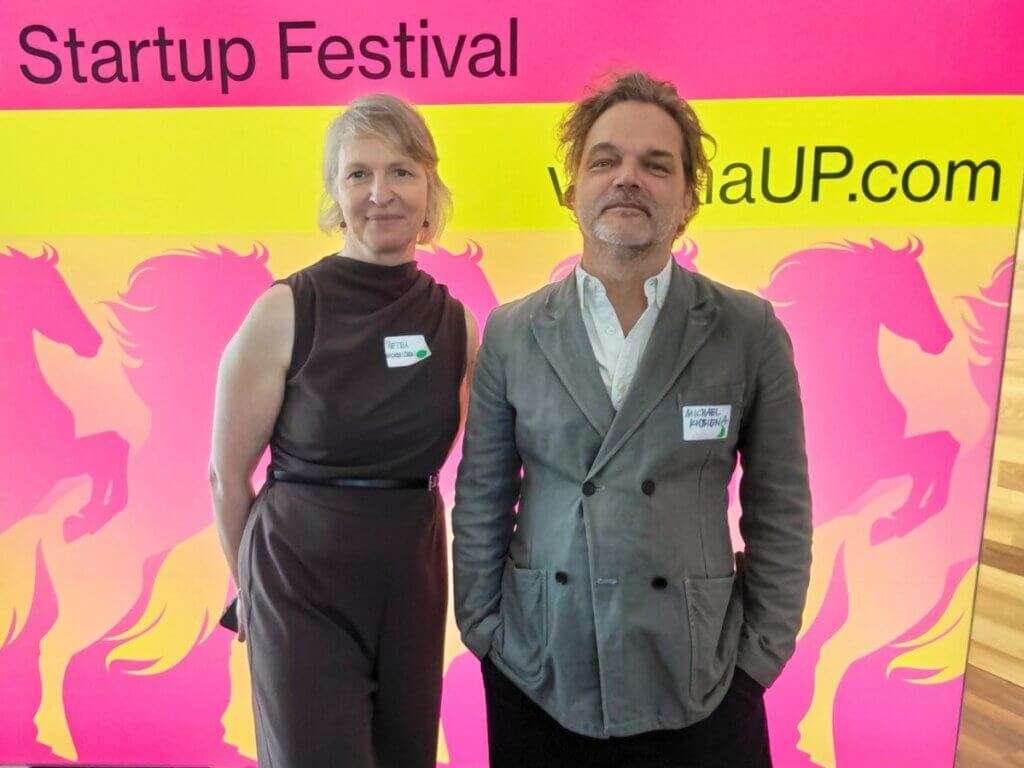
On May 20, 2026, Konsultori co-organised LAB TO LEADER as part of ViennaUP 2026 – Vienna’s annual city-wide startup and innovation festival, running May 18 to 22, initiated by Vienna Business Agency. We were proud to be part of it with an event that brought together 150 founders, researchers, spin-off teams, accelerator managers, and ecosystem builders from 19 countries at TU in the Sky for a full day focused on two challenges every science venture faces: finding the right cofounder and scaling successfully.
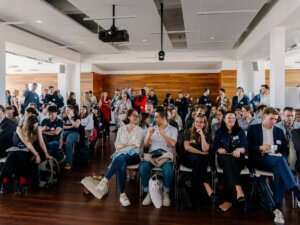
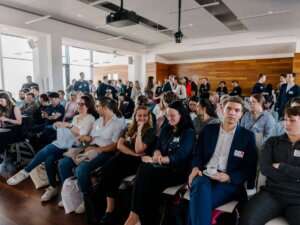
The location set the tone. Floor-to-ceiling windows, Vienna’s rooftops stretching out below, and a genuinely international crowd – the kind of mix that ViennaUP creates each year and that makes it worth flying in for. The energy in the room was open and engaged from the start, and it stayed that way throughout the day.
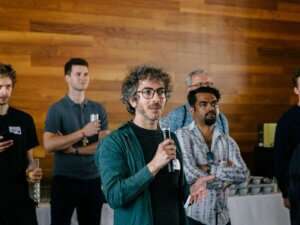

Vienna’s Universities and Enablers Unite for Deep Tech Spin-Off Founders
LAB TO LEADER was built on a shared conviction across Vienna’s innovation ecosystem: that supporting science ventures works better when institutions work together rather than in parallel.
The Vienna Spin-Off Project – a joint initiative of AIT Austrian Institute of Technology, BOKU, MedUni Wien, TU Wien, University of Vienna, WU Vienna, and XISTA and Vienna Business Agency – joined forces with AWS Austria Wirtschaftsservice, New Venture Scouting, and Konsultori to bring this event to life. Each institution brought something the others couldn’t: deep research pipelines and spin-off communities from the universities, market knowledge and investment connections from the enablers, and hands-on programme design and moderation from Konsultori. What the day reflected was what the Vienna ecosystem looks like when it comes together around a shared goal.
The Vienna Spin-Off Project was launched in June 2025 as a collaborative platform – not a new institution, but a shared effort to reduce fragmentation across Vienna’s spin-off ecosystem, align support structures, and make it easier for research-based ventures to emerge and develop sustainably. The initiative is built on a straightforward premise: many of the challenges academic founders face are shared across institutions, and addressing them together is more effective than doing so in isolation.
Science-based spin-offs are a key lever for Europe’s innovative capacity and technological sovereignty. With the Academic Spin-out Alliance, we are for the first time deliberately pooling our expertise to offer researchers better conditions for successful company formation, faster technology transfer, and international scaling.
Academic Spin-out Alliance, as reported by Brutkasten
The numbers behind this matter. In 2018, around 12% of Austrian startups came from universities or research institutions. By 2025, according to the Austrian Startup Monitor, that figure had reached 23%. The pipeline of science ventures is growing. LAB TO LEADER was designed as a concrete response to that growth – a day where the ecosystem showed up for its founders, together. The event itself was the message.
Spin-Off Founders, Aspiring Co-Founders and Accelerators: Who Filled the Room
The room brought together exactly the mix this kind of event needs. Science entrepreneurs at every stage – from spin-offs in formation to pre-scaleups – came looking for cofounders and connections. Alongside them: aspiring founders with deep technical backgrounds, accelerator managers wanting an unfiltered view of what founders need, and investors and advisors with experience to share.
The skills in the room spanned molecular biology, medtech, AI, hardware, climate tech, and life sciences – combined with commercial and go-to-market expertise from people who had already built and scaled companies.
The day: how it unfolded
Welcome – Alexander Svejkovsky, AIT on behalf of the Vienna Spin-Off Project
Alexander Svejkovsky opened the day on behalf of the Vienna Spin-Off Project, setting the context for why this collaboration exists: to reduce fragmentation across Vienna’s spin-off ecosystem, share knowledge among institutions, and create conditions in which research-based ventures can emerge more easily and grow more sustainably.
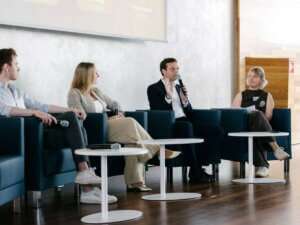
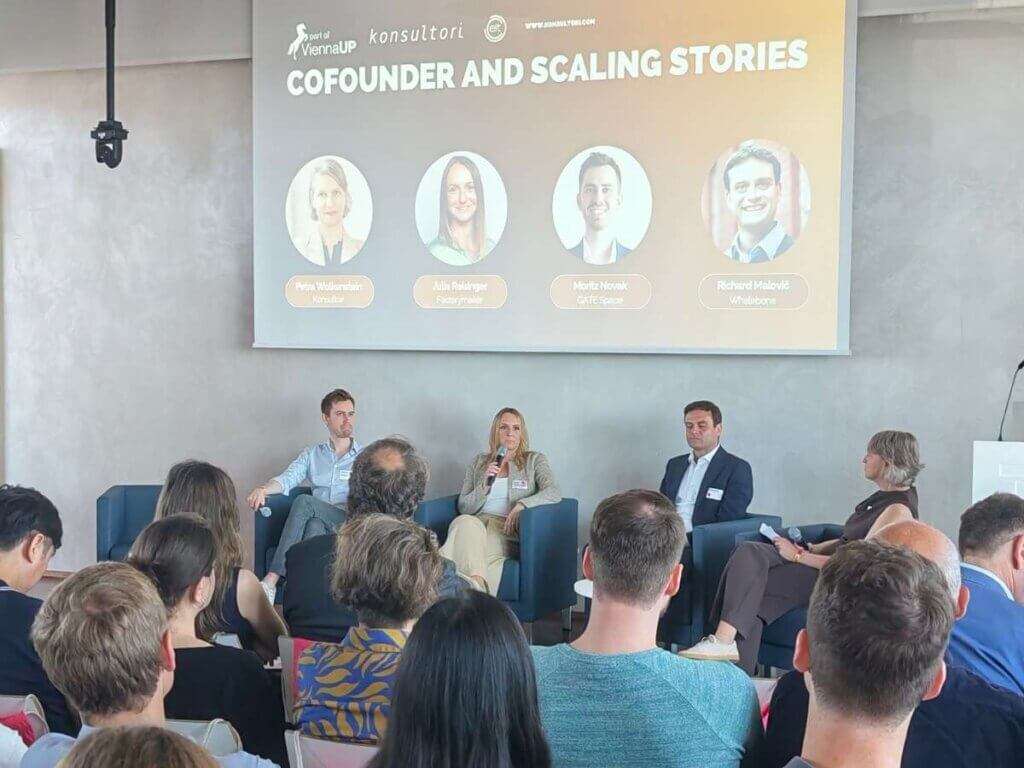
Panel: “Cofounder and Scaling Stories – Wins, Woes & Needs”
Moderated by Petra Wolkenstein, the morning panel brought together three founders who have been through the full arc of building a science venture – and were willing to talk about it honestly.
Richard Malovič – CEO & Co-Founder, Whalebone
Richard is the CEO and Co-Founder of Whalebone, a global leader in DNS-based cybersecurity and leader of the European Union’s DNS4EU consortium. Under his leadership, Whalebone has grown into a globally trusted venture protecting millions of users through a vast network of communication service providers worldwide. At LAB TO LEADER, he shared what it actually takes to scale a deep tech startup from Central Europe to global markets.
Moritz Novak – CEO & Co-Founder, GATE Space
Moritz is the Co-Founder and CEO of GATE Space, a Vienna-based deep tech startup revolutionising orbital mobility. A TU Wien spin-off and Forbes 30 Under 30 venture, GATE Space has rapidly established itself as one of Europe’s most ambitious New Space companies – with a SpaceX launch on the horizon. At Lab to Leader, Moritz shared his perspective on leading a multi-headed cofounder team and navigating the challenges of scaling in deep tech.
Julia Reisinger – CPO & Co-Founder, Factorymaker
Julia specialises in AI-automated industrial building design, bridging the gap between research and series production. A TU Wien spin-off, Factorymaker, has secured significant funding and won the PHÖNIX Female Entrepreneur Prize. Her platform automates complex planning, significantly reducing construction costs and carbon footprints for industrial leaders. At Lab to Leader, Julia shared her scaling journey from deep tech vision to industrial reality.
The panel covered what happens to cofounder relationships under pressure, how founding teams restructure as companies grow, and what the panellists wished the ecosystem had offered them earlier. It was a lively, candid conversation – exactly the kind that rarely makes it onto a stage.
Austria ranks among the top EU countries for R&D spending (3.2% of our GDP in research). Yet, the rate at which we translate it into market-scaling spin-offs remains lower.
At our “Lab-to-Leader” panel, we chose to skip the standard startup PR. Instead, I sat down with three exceptional founders (…) to talk about the real structural bottlenecks that early-stage deeptech faces.
1️⃣ The Founder Sweet Spot
Too many brilliant technical founders try to carry the entire weight of scaling on their own shoulders. The operational complexity of deeptech is simply too vast for one person. The most resilient scale-ups have 3-4 cofounders. Moritz Novak (GATE Space) started with seven cofounders. While managing them requires immense coordination, it gave them unmatched early resilience. All seven were quite literally willing to die for the company.
2️⃣ Why Cofounder Alignment Matters Early On
According to Harvard Business School research, 65% of high-potential startup failures are due to cofounder conflict. Yet, we still see spin-offs launching without vesting schemes or clear founding agreements. As Richard Malovič (Whalebone) candidly shared: “It’s like a marriage. A corporate split-up can easily destroy 70% of the company’s value. If you aren’t ready for a long-term commitment with clear vesting and exit rules, you aren’t ready to build together.”
3️⃣ Navigating the Premature Scaling Trap
74% of failures are caused by premature scaling (Startup Genome Project ). If a spin-off is two years old and has not validated its MVP, it is in a vulnerable position. Julia Reisinger (Factorymaker): face the market and charge for pilot projects from day one. If a customer is not willing to invest even a small amount (like €1,000) for an early trial, you have a problem.
4️⃣ Aligning TTO Clauses with International Standards
While there are excellent international benchmarks, we still see Austrian spin-offs facing highly restrictive contract clauses early on. Follow-on venture capitalists see immediate structural hurdles and often choose to pass.
The Path Forward: Unified Quality Over Fragmented Silos Austria is too small to have fragmented, localized incubation programs operating in isolation. Every institution looking out only for its own backyard is highly inefficient for global scaling.
I am so incredibly proud to see the Vienna Spin-Off Alliance joining forces. We need unified, high-quality, internationally networked support that integrates experienced, business-minded entrepreneurs into technical teams early.
Let’s focus our energy on structuring our spin-offs for long-term survival and global market entry.Petra Wolkenstein, LinkedIn
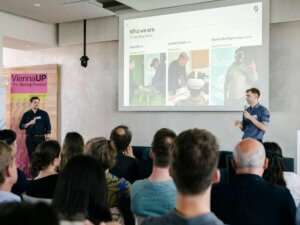
Cofounder Matching – startup pitches
Seven spin-offs from across Austria’s university ecosystem took the floor to pitch for the missing piece of their founding team. A big thank you to each of them for having the courage to stand up and ask:
- Lukas Kroeniger and Jakob Uhl – RISCARO (AIT)
- Harald Bartsch – Terraformer GmbH (WU)
- Manuel Reithofer – RemBac Environmental (BOKU)
- Carlotta Tubeuf and Martin Fischer – CLEO (TU Wien)
- Jen Iofinova – Panza (XISTA)
- Stephan Haudum – Resorbink (JKU)
- Nadiia Gumerova – Pomed (UniWien)
The conversations that started in that session continued through the guided networking and well past the official close of the day.
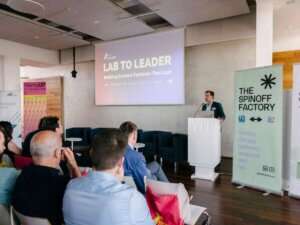
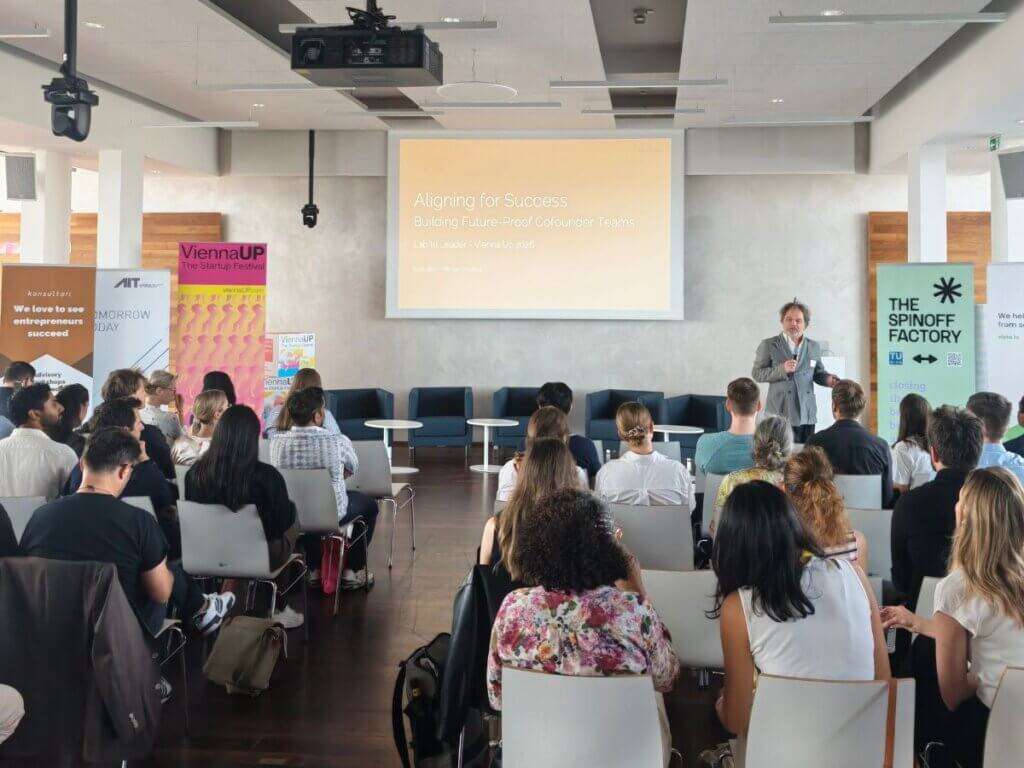
Keynote: “Aligning for Success – Building Future-Proof Cofounder Teams” – Michael Kubiena, Konsultori
Michael Kubiena’s keynote addressed one of the most underestimated risks in early-stage ventures: founding teams that never explicitly align on values, roles, and decision-making – until the moment those gaps become costly. With 25 years of experience in organisation design across Central and South-eastern Europe, Michael laid out a practical framework for building cofounder teams that are designed to last.
Session: “How to Build a Dream Team – Why Interdisciplinarity is Key”
Birgit Hochenegger-Stoirer (Quintus), Harald Jenull (Alpen-Adria-Universität), Bea Robein (ArtWave), Hinnerk Hansen (Impact Hub Vienna), and Werner Wutscher (New Venture Scouting) closed the afternoon with a session on what makes founding teams work. The consistent finding: diversity of skills and backgrounds makes a team stronger – and so does the well-being of the people in it.
Bea Robein offered a taste of ArtWave’s work, using the arts and the power of voice as a practical tool for stress reduction and human potential – a reminder that great teams need the right conditions, not just the right skills.
Wrap-up & Closing – Markus Wanko, XISTA
Markus Wanko – Founder & Managing Partner, XISTA
Markus is the Founder and Managing Partner of the XISTA innovation ecosystem, with nearly two decades of international experience in venture capital, principal investment, and strategy consulting. With an academic foundation spanning MIT and TU Wien, he has held key roles at the European Investment Fund, Boston Consulting Group, and the Qatar Investment Authority. Today, he leads XISTA Science Ventures, XISTA Innovation, and XISTA Science Park – bridging breakthrough research and commercial success.
Markus closed the day on an encouraging note – reflecting on what the ecosystem had built together and what becomes possible when institutions, founders, and enablers keep showing up for each other beyond a single event.
Co-founder matching and Spin-off scaling: What LAB TO LEADER proved
LAB TO LEADER, as an event within ViennaUP 2026, carried a clear signal. Founders, aspiring founders, and ecosystem players from 19 countries spent a full day working on the two challenges that define whether a science venture makes it: finding the right co-founder and scaling successfully. Seven spin-offs pitched for their missing founding piece. Top founders spoke about what building and scaling a venture actually looks like – the cofounder dynamics, the hard decisions, and what they wished the support structures around them had offered earlier. Eleven institutions joined forces to make it happen – universities, enablers, and advisors aligned around a single purpose: building better conditions for the founders in that room.
A genuine thank you to every institution, speaker, and organiser who made the day possible – and to every founder who showed up, pitched, and made the most of the day.
At Konsultori, we work with deep tech founders at exactly the moments this day was built around – cofounder alignment, team structure, investor readiness, and scaling strategy. If something from LAB TO LEADER raised a question for your venture, we would like to hear it.