
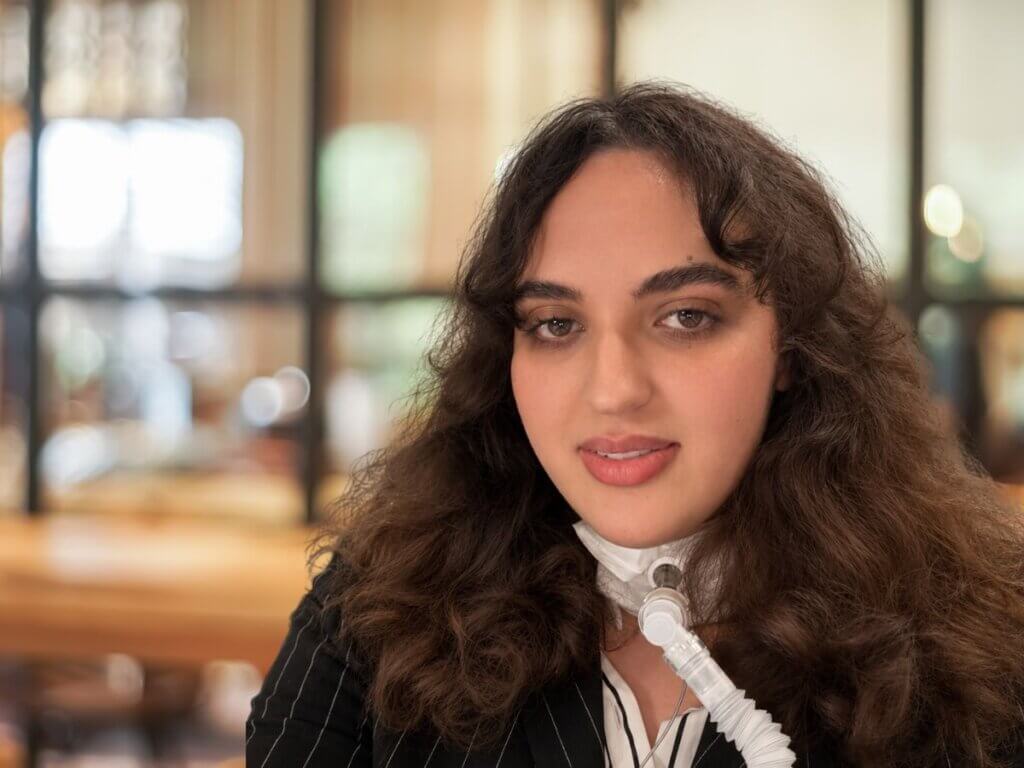
How do you build a new care model in a heavily regulated field like healthcare? And what if care didn’t start with what’s on offer, but with the life a person wants to live? Rita Fussenegger has an energy you don’t forget. She knows from her own experience where the healthcare system leaves gaps, and despite serious health challenges she has founded organisations that address exactly those gaps, including AufAtmen and AufAtmenSHG, the 21. Wienerschule and the association USE.
She is currently building AufAtmenWG, a new living and care model for people on ventilation or with a tracheostomy, which won at the Social Impact Award while still in its founding phase. Petra Wolkenstein supports Rita on selected strategic questions. In the interview, Rita explains why self-determination is her starting point and why, as a CEO, she doesn’t always have to be right.
Business Growth
We support you in reviewing your strategy.
What is your company’s success based on? Has there been a turning point in recent years?
Since the age of 19, I have founded several organisations, and right now I’m mainly working on building AufAtmenWG – a new living and care model for people with intensive care needs, on ventilation or with a tracheostomy. Even though we are still in the founding phase, we have already won at the Social Impact Award, attracted public interest over the years and brought important partners from medicine, nursing and politics on board. I believe this is mainly because we turn the conventional logic around. We don’t start by asking: “What care can we offer, and how does the person have to fit into it?” Instead we ask: “How does this individual person actually want to live – and what medical, nursing and social structures do we need to create to make exactly that life possible?”
For us, self-determination and “What does the patient want” are not an add-on, but the starting point of the business model. At the same time, I want to rethink working conditions in nursing. A good healthcare model has to work for both sides: for the people who need support, and for those who provide that support every day.
Honestly, we have turning points all the time. Some are positive – for example when political decision-makers suddenly understand why this gap in care needs to be closed. Others consist of realising that an idea is far harder to implement in Austria from a regulatory point of view than expected.
Especially in a heavily regulated field like healthcare, I keep learning: a strong vision doesn’t mean rigidly sticking to one path. The vision can stay the same – but the path towards it has to be allowed to change.
“A strategy is necessary because the future is unpredictable.” Do you agree? How do you approach strategy in your company?
Absolutely. Precisely because the future is unpredictable, you need strategy – but for me, strategy isn’t a document you write once and then work through for three years.
I draw a very clear line between vision and strategy: the vision describes where we want to go. The strategy describes how we get there under today’s conditions, with milestones. And that path can and must change.
That’s why at AufAtmenWG we work with concrete milestones, but review them continuously. Precisely because we are building a new care concept in a complex legal and political environment, a single conversation with the city, a healthcare provider or a potential partner organisation can change the next step. After important conversations, we deliberately go back to our strategy plan as a team, write down the key points and talk it through in person: What did we learn? Which assumption was wrong? What is changing? What is the most sensible next step now? Have the questions we went into the conversation with been answered, and do we need a follow-up email?
And there’s one more thing I consider important: a company’s vision should be bigger than the person who founded it.
As a founder, I therefore can’t build a system that only works as long as I keep the wheel turning myself every day. For me, good strategy also means building structures, teams and knowledge in a way that allows the organisation to grow without me in the long term. That’s something we’re still working on at AufAtmenWG.
What or who helps you most when you face a difficult business decision?
First, I try not to decide right away. Always sleep on it.
With difficult decisions, calm genuinely helps me listen to my gut feeling as well. I write a lot, reflect, and have developed certain small rituals to try to figure out: What are the facts right now, what is fear, what is my ego – and what do I truly believe is right?
Then I write a purely fact-based pro and con list, separate from my own thoughts about the decision.
After that, I deliberately seek outside perspectives. I’m lucky to have people in my circle of friends and mentors who know far more than I do in various fields. And I don’t necessarily ask the person I know will agree with me, but the one whose judgement I respect in exactly that area.
What matters most to me is having people around me with whom I’m allowed to change my mind. I’ve had conversations I went into completely convinced of my position and came out of thinking: “Okay, I was wrong.”
I don’t see that as a weakness. On the contrary: as a CEO, I don’t always have to be right. I have to create an environment in which the best idea can win – even if it wasn’t mine.
And right before I decide, I always come back to my gut feeling.
If you could have one superpower, what would it be?
Definitely: being able to create time. Unfortunately, I have a lot of ideas. A lot. [laughs]
Besides AufAtmen, I work on several organisations and projects and have now also started working on research and innovation topics. The fact that this is possible at all is mainly because I have great teams and have learned to hand over responsibility.
Still, I regularly catch myself thinking: why does a day only have 24 hours?
So if I could choose a superpower, I wouldn’t want to fly or read minds. I’d like the ability to simply turn 24 hours into 48 – ideally including eight hours of sleep.
But maybe there’s a business lesson in that too: I will never have enough time to implement every good idea myself. So increasingly, my real job isn’t to do everything myself, but to find the right people, delegate and trust their expertise, so that together we can turn ideas into reality.
What are you most proud of?
I think I’m most proud of the person I’ve become.
I’m 24 today and spent a large part of my youth and young adulthood seriously ill, at times in hospital for long periods. There was a point when the more likely path for me would not have been entrepreneurship, international projects or self-employment, but permanent institutional long-term care.
The life I lead today was not the most likely path.
And that’s exactly what I’m proud of: that despite everything, I didn’t stop imagining a future – but started building it step by step myself, from the intensive care unit.
I couldn’t choose my illness. Nor many of the circumstances. But at some point I could decide what to do with what happened to me.
Maybe that’s also the attitude behind almost everything I found:
A problem can take a great deal from you. But when you start looking for a solution, you get back a piece of agency. And sometimes the very solution you once desperately needed yourself becomes something that later changes the lives of many other people too.
Business Growth
We support you in reviewing your strategy.