

Hiring the right people is hard. Keeping them is harder. For startups and SMEs operating in competitive talent markets, employee retention is one of the most consequential – and most underinvested – areas of business management. The cost of losing a key employee typically runs between 50% and 200% of their annual salary once you factor in lost productivity, recruiting fees, and onboarding time. For a 20-person team, even one or two preventable exits can set back growth by months.
Yet most founders and SME leaders do not have a deliberate employee retention strategy. They have good intentions, competitive salaries, and the hope that people will stay because the mission is meaningful. That is rarely enough — and when it fails, the diagnosis is almost always the same: the employee value proposition was never consciously designed.
This post outlines what employee retention strategies actually look like in practice, why they matter beyond cost savings, and how growing organisations can build them without a large HR budget or a dedicated people team.
What are Employee Retention Strategies?
Employee retention strategies are the deliberate actions an organisation takes to keep employees engaged, satisfied, and committed over time. They go beyond pay and benefits to address the full experience of working somewhere:
- the clarity of the role and what success looks like
- the quality of leadership and day-to-day management
- opportunities for growth and development
- the sense that the work is meaningful and the company is worth staying for
The distinction between a retention strategy and a retention gesture matters. Offering a ping-pong table or an annual team dinner is a gesture. A retention strategy is a structured approach that diagnoses why people leave, identifies what makes people stay, and builds those conditions systematically into how the organisation operates.
Gartner’s CHRO Guide on reinventing the Employee Value Proposition frames it well: the shift organisations need to make is from designing for workers to designing for people — and from focusing on the work experience alone to addressing what employees need across their whole life experience. Employee retention strategies that ignore this distinction tend to invest in the wrong things.
Why Employee Retention Matters for Business Success
High turnover is expensive, but the damage goes well beyond the replacement cost. When experienced people leave, they take institutional knowledge, client relationships, and team momentum with them. Retention is not a people problem – it is a business performance problem.
Gartner’s 2021 EVP Employee Survey (n = 5,000 employees worldwide) produced findings that translate directly into measurable business outcomes:
- 28% increase in employees highly likely to recommend the organisation – driven by deeper connections
- 18% increase in high performers – driven by radical flexibility
- 9% increase in employees who would choose to work there again – driven by shared purpose
- 7% improvement in physical, financial and mental wellness – driven by holistic wellbeing
- 6% increase in intent to stay – driven by personal growth
These are not soft metrics. They describe the conditions under which people perform, refer others, and commit for the long term. For a startup or SME competing for talent against larger, better-resourced organisations, building these conditions is one of the few genuine competitive advantages available.
How to Identify the Main Causes of Employee Turnover
Before building employee retention strategies, you need to understand why people are actually leaving – and the answer is rarely the one given in the exit interview. People rarely say “I left because my role was never clearly defined.” They say they found a better opportunity. That is almost always true, but it describes the trigger, not the cause.
The real causes of turnover in growing companies cluster around a predictable set of failure points:
- Unclear roles and misaligned expectations – people join with one understanding of their job and discover a different reality within months
- Lack of visible growth – when employees cannot see where they are going, they start looking elsewhere
- Poor management quality – the relationship with a direct manager remains one of the strongest predictors of retention or attrition
- Absence of psychological safety – people who do not feel safe to speak up or make mistakes disengage before they leave
- A gap between stated values and lived experience – when what the company claims to stand for does not match day-to-day reality, trust erodes quickly
A useful starting point is an honest internal audit: review recent departures, run structured conversations with current employees (not just satisfaction surveys), and map the gap between what your employer brand promises and what the day-to-day experience actually delivers. That gap is where your retention risk lives.
Building a Positive Workplace Culture to Retain Employees
Workplace culture is the dimension of employee retention that leaders most often cite and least often actively shape. Culture does not emerge from values on a wall or an annual away day. It emerges from the patterns of behaviour that leadership models and tolerates every day:
- how feedback is given and received
- how mistakes are handled
- how decisions get made and communicated
- who gets recognised and why
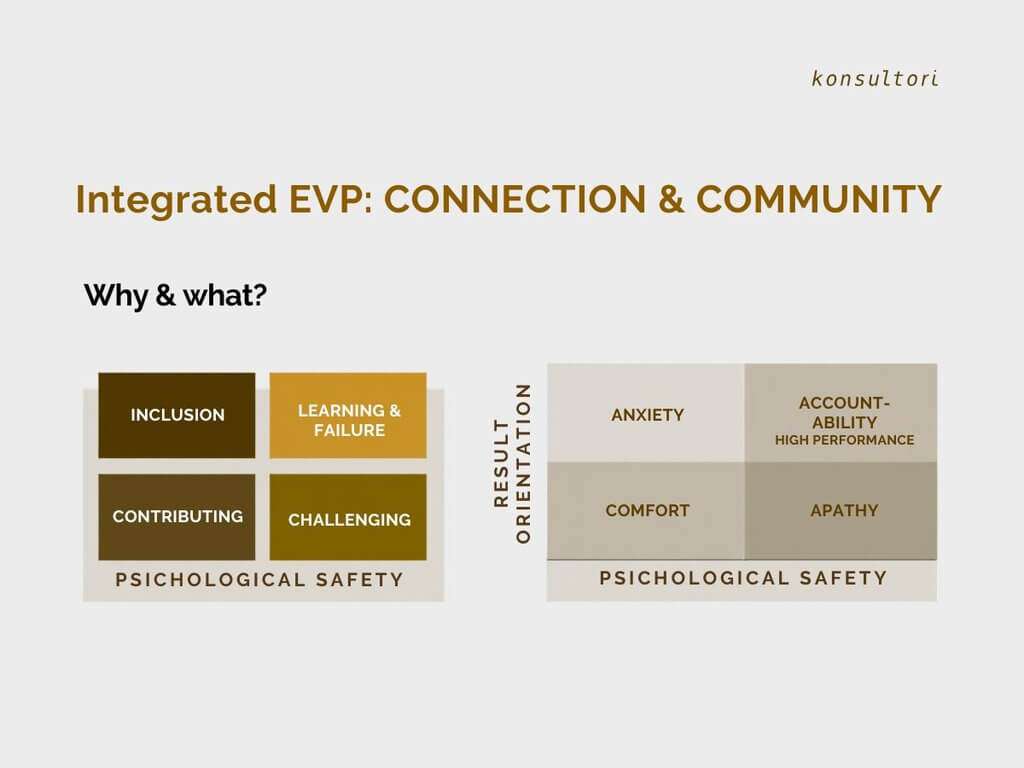
Gartner’s research on deeper connections identifies the specific attributes that build the kind of culture people stay for:
- camaraderie and a collegial work environment
- diversity, equity and inclusion
- co-worker quality
- manager and leadership quality
- family and community support
At the foundation of all of these is psychological safety – the condition under which people feel genuinely able to speak up, contribute, challenge, and learn from failure without fear of judgment or consequence.
For startups and SMEs, this has a practical implication: culture is built or broken in one-on-one interactions between managers and employees, not in company-wide programmes. Training and supporting line managers to have better conversations, give clearer feedback, and create genuine space for their team members is one of the highest-leverage investments a growing organisation can make in retention.
Improving Employee Engagement and Satisfaction
Employee engagement is not the same as employee satisfaction, and the distinction matters for retention strategy. A satisfied employee is comfortable. An engaged employee is committed — they care about the outcome, take initiative, and go beyond the minimum.
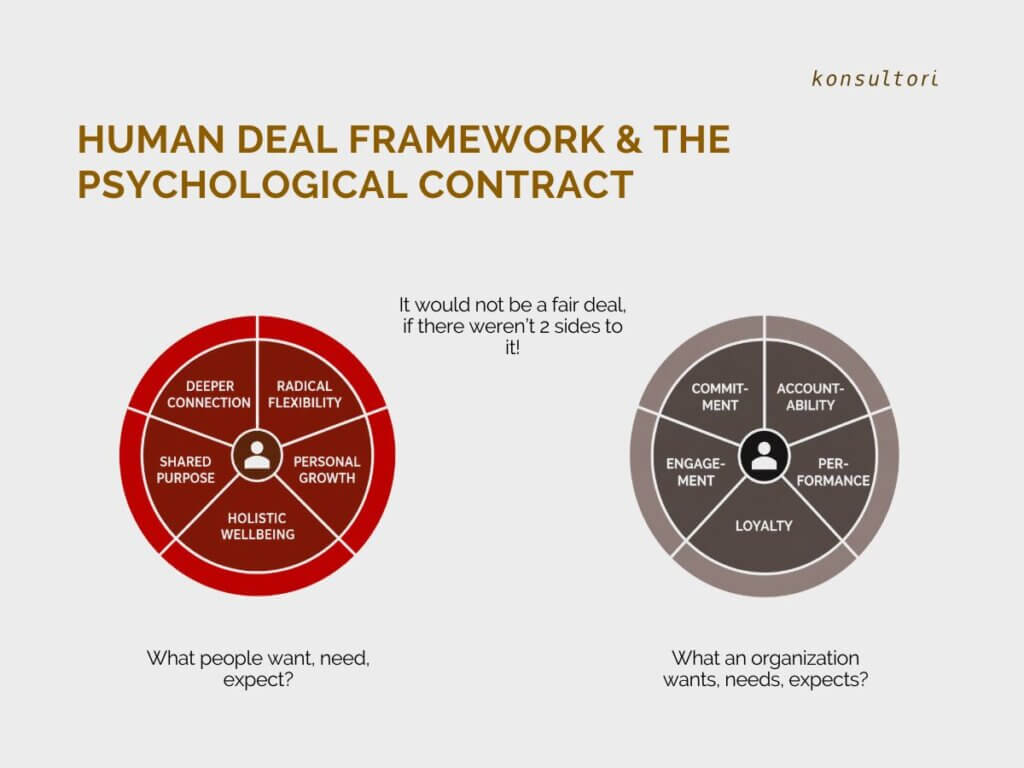
Gartner’s Human Deal framework identifies what drives genuine engagement:
- Shared purpose – employees feel invested in the organisation’s direction and values
- Personal growth – employees are developing as people, not just as professionals
- Radical flexibility – employees have real autonomy over how, where, and when they work
- Holistic wellbeing – employees feel genuinely cared for, not just offered a wellness app
- Deeper connections – employees feel understood, included, and part of something
Organisations that orient their employee retention strategies around these dimensions – rather than around features like salary and office perks – see engagement that holds over time, not just in the months after a pay review.
The engagement lever we see most consistently underused in our work with founders and SME leadership teams is purpose communication. Employees who understand how their specific work connects to the organisation’s direction, and who have had some genuine role in shaping it, are far less likely to disengage quietly. This does not require elaborate strategy cascades. It requires regular, honest conversation about where the company is going and why their contribution matters.
Common Employee Retention Mistakes to Avoid
The most expensive retention mistake is reacting too late. By the time an employee hands in their notice, the decision has usually been forming for months. Retention strategies triggered by resignations are not strategies – they are firefighting.
Other common mistakes we see in growing organisations:
Treating retention as solely an HR responsibility.
The EVP is designed by HR but delivered by managers and peers. If leadership does not own the culture and the day-to-day experience, no HR programme will compensate for it.
Investing in benefits employees do not value.
Gartner’s research is clear: benefits perceived as out of sync with employees’ actual life stage or preferences are simply invisible. Before adding a new benefit, find out whether your current ones are actually being used.
Assuming competitive pay solves everything.
Pay is a hygiene factor – it eliminates a reason to leave, but it rarely creates a reason to stay. Retention strategies built primarily on compensation will keep people until someone offers more.
Ignoring the onboarding window.
The first 90 days are when employees decide whether the organisation matches what they were promised. Poor onboarding is one of the fastest routes to early attrition.
Confusing activity with strategy.
Running engagement surveys, team events, and development programmes in isolation — without a coherent framework connecting them – creates cost without impact.
Offering Career Development and Growth Opportunities
One of the most reliable predictors of long-term retention is whether employees believe they have a future in the organisation. When that belief fades, people begin looking for one elsewhere.
Gartner recommends empowering employees to actively design their own development, including communicating preferences around:
- when and how they want to grow
- with whom they want to learn
- what the outcome should look like – a new role, a skill, an accreditation
For startups and SMEs without formal development programmes, this translates into a practical discipline: make growth a standing topic in regular one-on-one conversations, not just in annual reviews. Ask people where they want to go. Identify what stands between them and that goal. Find ways to close the gap – through new responsibilities, mentoring, external learning, or stretch assignments.
What employees need, at its core, is to feel that the organisation is invested in their future – not just their current output. That signal, delivered consistently, does more for retention than most formal programmes.
Measuring the Success of Your Employee Retention Strategy
What gets measured gets managed. Employee retention strategies without clear metrics tend to drift — investment gets made, but nobody knows whether it is working.
Key metrics to track:
- Retention rate – the percentage of employees who remain over a given period, tracked annually and by team or function
- Voluntary turnover rate – the proportion of departures that were employee-initiated, which tells you more about why people are choosing to leave than overall turnover figures
- Intent to stay – tracked through regular pulse surveys, this is the most useful leading indicator before exits happen
- Engagement scores – structured pulse surveys on psychological safety, purpose alignment, and growth perception give early signal
- Exit interview patterns – properly structured and consistently analysed, they reveal systemic causes invisible from headline numbers
For startups and SMEs, keep the measurement framework simple. Track two or three metrics consistently over time. Complexity does not add value at this stage. Consistency does.
From Compliance to Strategic Advantage on the Labour Market
Michael Kubiena recently worked with an SME in the digital-hitech space on their job architecture and compensation strategy. While the project was triggered by the EU’s pay transparency directive, it was clear from the very start that this is not merely about compliance. Compensation practices based on principles of fairness and transparency are an integral part of a company’s employee value proposition – a framework which resonates well not only with HR professionals but, first and foremost, with business leaders.
How We Can Help
At Konsultori, we help startups and SMEs build employee retention strategies that are grounded in how their organisation actually works – not in generic HR templates. Our work is led by Michael Kubiena, with over 25 years of experience in HR, organisation design, and leadership development across Central and Southeastern Europe, startups, and international corporations.
Specifically, we help you with:
- Organisational and HR audits to identify the root causes of turnover and disengagement
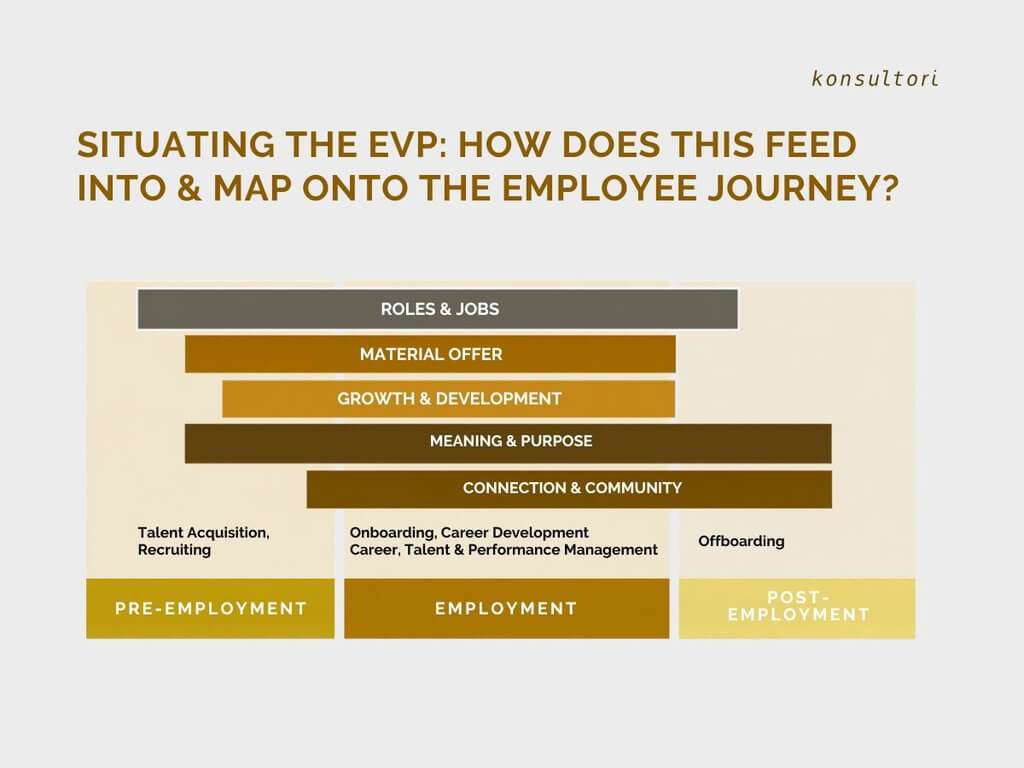
- Designing a structured Employee Value Proposition across all five dimensions – Roles and Jobs, Material Offer, Growth and Development, Meaning and Purpose, and Connection and Community
- Building the HR function your organisation needs for its current stage and size
- Translating strategy into concrete instruments: job profiles, competency frameworks, compensation architecture, onboarding processes, and development planning
- Supporting implementation so that what is designed actually gets lived
-> Compensation architecture and performance management via OKRs